“Zealous, yet modest; innocent, though free; Patient of toil, serene amidst alarms; Inflexible in faith, invincible in arms.”
“He hath denied the faith, and is worse than an infidel.”
Beattie paints a portrait of unyielding virtue, a figure fortified against the world. Uhland, however, condemns a lapse in faith as a profound betrayal. Imagine a soldier, decorated for bravery, who later deserts. Is he still the hero we celebrated? Or has his single act of apostasy erased all prior good? Epictetus and Dostoevsky lock horns over this: Is virtue a constant state, or a fragile ideal constantly threatened by human fallibility? Our capacity for forgiveness hangs in the balance.
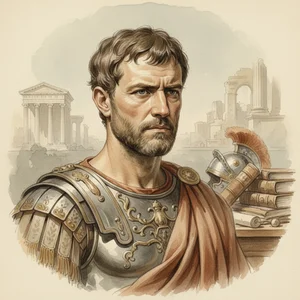
EpictetusvsFyodor Dostoevsky
Can unwavering commitment to virtue, however admirable, blind us to the humanity of those who falter?
Humanity? Faugh. As if "humanity" were some undifferentiated mass, rather than a collection of individuals, each capable of reason or enslaved to their appetites. This hand-wringing over the fallen soldier – is he still a hero? – misses the point entirely. Virtue is not a single act, but a practiced disposition. The soldier who deserts proves he valued something – comfort, perhaps, or safety – more than his duty. He was given a role to play, and he played it poorly. Forgiveness? Perhaps, for the sake of the city. But let us not mistake compassion for delusion. I have told my students repeatedly: externals are not up to us. But what we make of them, how we judge them – that is the measure of a man.
Whether unwavering commitment to virtue blinds us to the humanity of those who falter? It is a question for parlor philosophers who have never stood before a firing squad. Virtue, like faith, is not a suit of clothes one wears without stain. A man can be brave in one moment and a coward in the next. He can love humanity and despise his neighbor. This is not hypocrisy; it is the condition of being human. To deny humanity to the one who falters is to deny the very possibility of redemption. Did Raskolnikov’s crime negate the man? Or was it through the abyss of his sin that he found his way back to the light? The soldier who deserts may be a villain, but he is still a man, and his fallibility is precisely what binds us to him. Forgiveness is not absolution, but recognition—that even in betrayal, humanity persists.
0 votes total