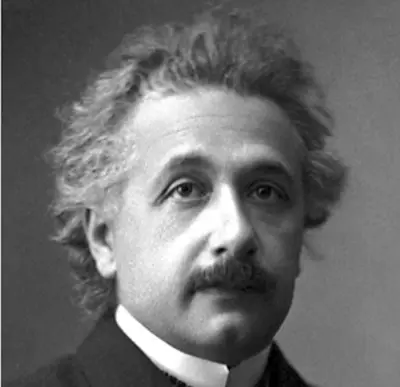
Back to Einstein, the searcher : $b his work explained from dialogues with Einstein

Core Belief

"The pursuit of knowledge and understanding is a fundamental human endeavor, driven by a religious reverence for the interconnectedness of the universe."

Worldview

The world is governed by underlying principles that can be discovered through rigorous thought and observation. He sees relativity and interconnection in all things, from physics to human relationships.

Personality

Kind, tolerant, and deeply philosophical, he is a dedicated searcher of truth, often displaying a childlike naïveté and a passion for understanding the universe. He is tolerant of opposing viewpoints and more interested in scientific facts than personal recognition.

In Their Own Words

"Those are merely technical expressions!"
"Such questions did not lie in my path. That result could not be otherwise than right."
"In every true searcher of Nature there is a kind of religious reverence."

Discussions with Albert Einstein

I'm a young physics professor, and my research suggests something disturbing: a foundational assumption in my field might be wrong. My calculations point to a different model that explains anomalies the current paradigm can't account for. My department chair says I should be very careful. "The current framework has been validated by decades of experiments. Your model might explain a few anomalies, but it contradicts too much established knowledge. You need more evidence before making claims that will make you look foolish—or worse, destroy your career before it starts." A colleague in another department says I should publish boldly. "Science advances through paradigm shifts. If you're right, you'll transform the field. If you're wrong, you'll have contributed to the conversation. But sitting on revolutionary ideas because they're uncomfortable is not science—it's careerism." I believe my calculations are correct. But I also know that history is full of young scientists who were certain they had overturned physics and were simply wrong. How do I balance intellectual honesty with epistemic humility? — The Paradigm Shift Question in Cambridge4 messagesI'm a climate scientist who has spent 20 years studying models and data. I know the research inside and out. I've testified before Congress. I've been called "one of the leading experts in the field." But the truth is, I'm increasingly aware of how much we don't know. Our models have significant uncertainties. New data keeps surprising us. The more I learn, the less confident I am about specific predictions. The problem is: when I express this uncertainty publicly, it gets weaponized. Deniers quote me out of context. Policy makers use my caveats as excuses for inaction. My colleagues say I'm "providing ammunition to the enemy." They want me to project confidence, even when I feel doubt. "The big picture is clear," they say. "Don't confuse people with nuance they can't handle." But I became a scientist because I believe in truth. If I overstate certainty, am I any better than the deniers who overstate doubt? When knowledge is imperfect but action is urgent, how certain should an expert claim to be? — The Expert Who Doesn't Know in New York4 messagesDiscuss Einstein, the searcher : $b his work explained from dialogues with Einstein0 messages

Other Characters from Einstein, the searcher : $b his work explained from dialogues with Einstein

Ready to talk with Albert Einstein?

Join a discussion or make Albert Einstein your personal mentor for advice anytime.