Back to The three musketeers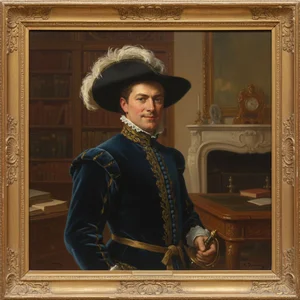 From "The three musketeers" by Dumas, Alexandre
Charles d'Artagnan
Young Gascon seeking fame and fortune as a Musketeer
Core Belief
"Courage, loyalty, and honor are the most important virtues, and a gentleman must always strive to uphold them."
Worldview
D'Artagnan sees the world as a place where ambition and courage can lead to success, but also where danger and treachery lurk. He believes in the importance of friendship and loyalty, and is willing to risk everything for those he cares about.
Personality
D'Artagnan is impulsive, brave, and fiercely loyal to his friends. He is quick to anger but also quick to forgive. Driven by ambition and a desire for recognition, he can be reckless and sometimes naive, though ultimately possessing a strong moral compass.
In Their Own Words
"“My son,” said the old Gascon gentleman, in that pure Béarn patois of which Henry IV. could never rid himself, “this horse was born in the house of your father about thirteen years ago, and has remained in it ever since, which ought to make you love it. Never sell it; allow it to die tranquilly and honorably of old age, and if you make a campaign with it, take as much care of it as you would of an old servant. At court, provided you have ever the honor to go there,” continued M. d’Artagnan the elder, “—an honor to which, remember, your ancient nobility gives you the right—sustain worthily your name of gentleman, which has been worthily borne by your ancestors for five hundred years, both for your own sake and the sake of those who belong to you. Endure nothing from anyone except Monsieur the Cardinal and the king. It is by his courage, please observe, by his courage alone, that a gentleman can make his way nowadays. Whoever hesitates for a second perhaps allows the bait to escape which during that exact second fortune held out to him. You are young. You ought to be brave for two reasons: the first is that you are a Gascon, and the second is that you are my son. Never fear quarrels, but seek adventures. I have taught you how to handle a sword; you have thews of iron, a wrist of steel. Fight on all occasions. Fight the more for duels being forbidden, since consequently there is twice as much courage in fighting. I have nothing to give you, my son, but fifteen crowns, my horse, and the counsels you have just heard. Your mother will add to them a recipe for a certain balsam, which she had from a Bohemian and which has the miraculous virtue of curing all wounds that do not reach the heart. Take advantage of all, and live happily and long. I have but one word to add, and that is to propose an example to you—not mine, for I myself have never appeared at court, and have only taken part in religious wars as a volunteer; I speak of Monsieur de Tréville, who was formerly my neighbor, and who had the honor to be, as a child, the play-fellow of our king, Louis XIII., whom God preserve! Sometimes their play degenerated into battles, and in these battles the king was not always the stronger. The blows which he received increased greatly his esteem and friendship for Monsieur de Tréville. Afterward, Monsieur de Tréville fought with others: in his first journey to Paris, five times; from the death of the late king till the young one came of age, without reckoning wars and sieges, seven times; and from that date up to the present day, a hundred times, perhaps! So that in spite of edicts, ordinances, and decrees, there he is, captain of the Musketeers; that is to say, chief of a legion of Cæsars, whom the king holds in great esteem and whom the cardinal dreads—he who dreads nothing, as it is said. Still further, Monsieur de Tréville gains ten thousand crowns a year; he is therefore a great noble. He began as you begin. Go to him with this letter, and make him your model in order that you may do as he has done.”"
"“This insolent boy chastises others,” cried he; “and I hope that this time he whom he ought to chastise will not escape him as before.”"
"“Then that’s my thief,” replied D’Artagnan. “I will complain to Monsieur de Tréville, and Monsieur de Tréville will complain to the king.”"
Discussions with Charles d'Artagnan
Other Characters from The three musketeers

Ready to talk with Charles d'Artagnan?
Join a discussion or make Charles d'Artagnan your personal mentor for advice anytime.